
You saved a day making the ad. Then a customer asks whether the product in it actually does what you showed. That’s the expensive question: if the answer takes an explanation, the ad may have made the sale harder.
Before you decide what to generate, underline the one thing you’re asking a buyer to believe. If it’s how your product works, film it working. If it’s what a customer experienced, use a real account with permission. Then use AI to make the message easier to produce, understand, and test.
Why customers draw a line
The debate over AI in advertising is showing up in platform tools, too. In November, Reddit announced new options for advertisers to disclose AI use. The question for a small business is what a buyer will reasonably take as real, even when a platform offers a label.
In the 2026 Bentley University–Gallup survey, 75% of U.S. adults said clearly disclosed AI assistance with brainstorming or early ad drafts was acceptable. By contrast, 62% said using AI to create people or voices for ads was unacceptable even with disclosure. Those are reported attitudes, not sales results. Still, they give you a reason to distinguish help behind the scenes from what buyers see and hear as evidence.
Decide what the ad has to prove
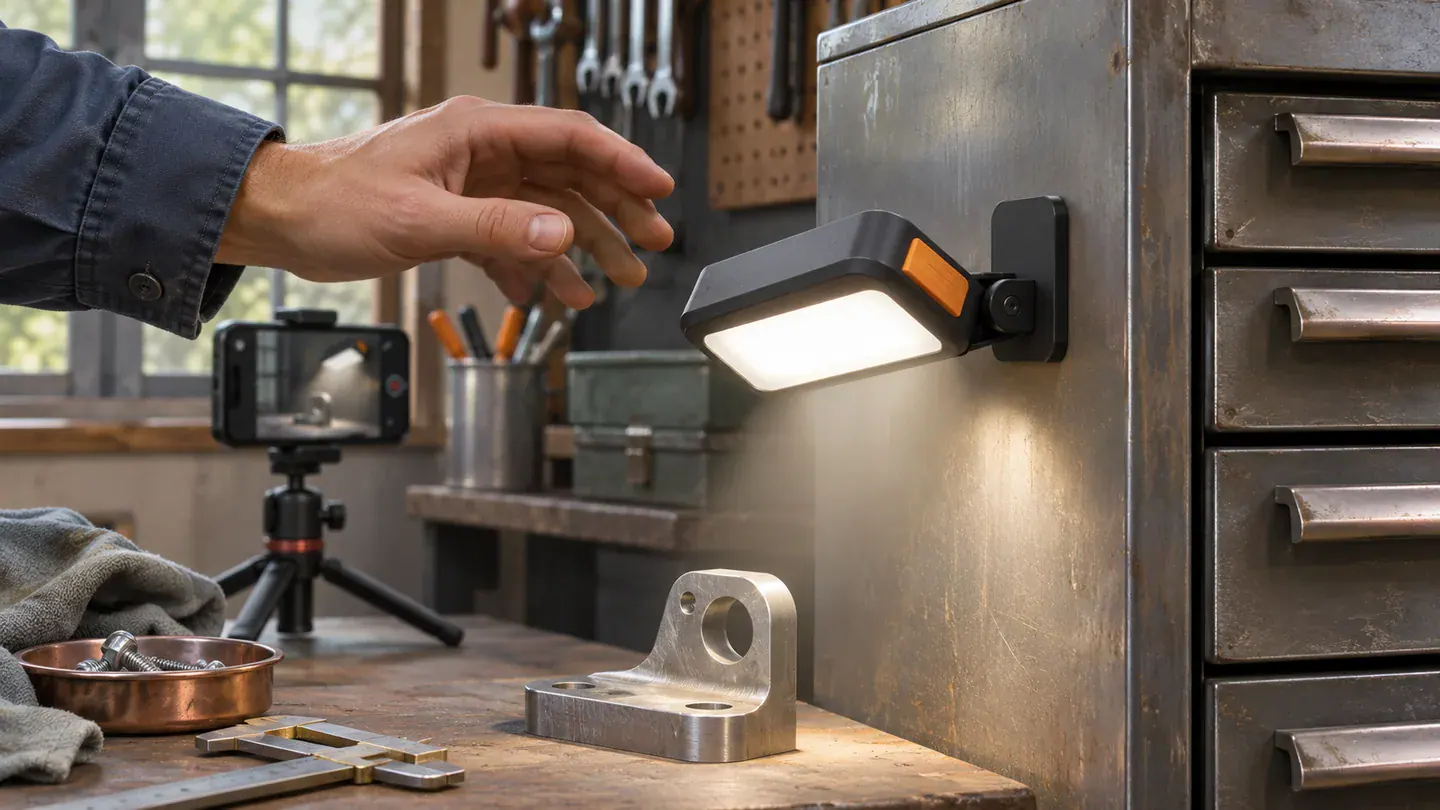
Say you sell a rechargeable work light with a magnetic base. You could generate a dramatic garage scene, complete with sparks and a perfectly lit engine bay. But a buyer may have a simpler question: will the light stay in place on the side of a steel cabinet and still aim where I need it? A close-up of the actual lamp attaching to steel and lighting a part answers that question directly.
Write a short brief before filming or opening an AI tool: “We want [buyer] to believe [specific claim], and we’ll show [evidence].” For the work light, the evidence is one continuous shot. For a service business, it could be a walk-through of what happens during the first appointment. For software, it could be a screen recording of a real workflow using sample data. Show the condition that matters: if the magnet works on steel, don’t imply it attaches to any surface.
If the product isn’t ready to film, show a clearly labeled concept and ask people to join the waitlist. That’s a different offer. A generated scene can help people picture an idea; it can’t establish that a prototype performs as shown. Keep a link to the original footage, spec sheet, or approved customer quote with your ad files so the next person who edits the campaign knows what’s been verified.
Use AI where it saves production time
You don’t need a large shoot to get credible material. Start with the simplest piece of proof and build variants around it.
- Before filming: Ask AI to turn recurring customer questions into a shot list and suggest three openings. Keep the questions you actually hear. Have the person who knows the product review the script.
- During editing: Use AI to draft captions, find usable moments in a transcript, or propose shorter versions. Watch the edits yourself. A caption that changes a measurement or a cut that skips an important condition can make the finished ad promise something the product doesn’t do.
- When adding generated material: Use it for a clearly illustrative scene, background, or visual explanation. A synthetic spokesperson can explain an offer, but give viewers no reason to mistake that character for a customer describing a real experience. The FTC’s rule on fake reviews and testimonials addresses invented testimonials, including AI-generated ones. Check the ad platform’s disclosure requirements before running the creative.
Before approving the ad, show it to someone who hasn’t seen the brief. Ask what they thought was real and what they think the product will do. If their answer is broader than your evidence, change the visual or the wording where that misunderstanding starts.
Check the page the ad sends people to as well. For the work light, put the real demonstration and the compatible surface right next to the product details. If the ad shows a cabinet mount and the page only shows a studio photo, the buyer has to take the claim on faith a second time. Use the same product, conditions, and offer across the ad and the page.
Test what buyers do after the click
Try two openings on the same demonstration: one starts with the buyer’s problem; the other opens on the product solving it. Use the same offer, landing page, and audience, with a budget cap you can afford. If your platform offers a split test, use it so the variants get a fair comparison. Keep each version tied to what you’re trying to learn.
Pick a result before launch: cost per qualified inquiry, booked demo, or purchase. Watch time and clicks can help you diagnose an opening. They can’t tell you on their own whether people understood the claim or wanted to buy. If inquiries rise but more people ask a question the ad was meant to answer, check the wording and landing page before increasing spend. If you only have a handful of conversions, treat the result as an early signal.
Bring one ad or one claim you want customers to believe. Book a free 15-minute call with Mediafluent and we’ll help you decide what to film, where AI can save time, and what to measure before spending more.