



Is Your Organization Aligned to Perform at Its Best?

Misalignment and hidden gaps between people, roles, workflows, leadership, and AI can quietly limit execution, efficiency and growth.

Take the free Optimal Alignment Assessment to identify where your organization is strong—and where it may be losing capacity.

Takes about 5-8 minutes. Receive an immediate result.

What's Holding Performance Back?

Even strong organizations can lose capacity through unclear roles, slow decisions, workflow friction, leadership dependency, and disconnected AI adoption.

Watch this brief video to see how the Optimal Alignment Initiative helps uncover those hidden gaps and how the free assessment can reveal where your organization stands.

Misalignment Is Often Invisible Until It Begins Limiting Growth

Organizational misalignment does not always appear as a major crisis. It often develops gradually through everyday friction.

Talent Underutilized

Employees are unclear about responsibilities or decision authority. Important knowledge is concentrated in a few key people. Leaders become approval bottlenecks.

Roles Don't Reflect Reality

Work is duplicated, delayed, or repeatedly corrected. High-performing employees become overloaded. Job descriptions no longer reflect the work people actually perform.

Workflow Friction

Talented employees are placed in roles that do not use their strengths. AI tools are introduced inconsistently or without defined outcomes. Teams rely on informal workarounds.

Your Organization May Be Losing More Than Time

Misalignment can affect nearly every area of performance:

  • Slower execution and delayed decisions
  • Leadership exhaustion
  • Employee frustration and disengagement
  • Inconsistent customer or client experiences
  • Underused talent and expertise
  • Higher operating costs
  • Difficulty scaling without adding unnecessary complexity
  • Poor adoption of new technology
  • AI investments that produce little measurable return
  • Increased dependence on a small number of essential employees

The greatest cost is often not what is going wrong today. It’s the performance, growth, and innovation the organization cannot achieve because its systems are not fully aligned.

OAI Office 4 v

Clutter Instead of Clarity

Organizations often respond to performance challenges by adding software, hiring employees, increasing meetings, restructuring departments, or purchasing AI tools.

These actions may help temporarily, but they often treat symptoms rather than the underlying operating system.

Before adding more resources, leaders need to understand how their existing people, roles, workflows, leadership practices, and technology currently function together.

OAI Office 4

Introducing The Optimal Alignment Initiative

The Optimal Alignment Initiative is a structured organizational alignment and optimization program designed for growing organizations, initially serving teams of 10–50 employees.

We evaluate the organization as an interconnected system.

The process examines:

  • Organizational vision and priorities
  • Employee strengths, skills, and experience
  • Official job descriptions and actual work performed
  • Responsibilities and decision authority
  • Leadership practices and dependencies
  • Workflows, handoffs, and recurring friction
  • Existing technology and AI usage
  • Opportunities for responsible AI integration

This analysis reveals where alignment is already strong, where capacity is being lost, and where focused improvements could create the greatest impact.

OAI Office 6

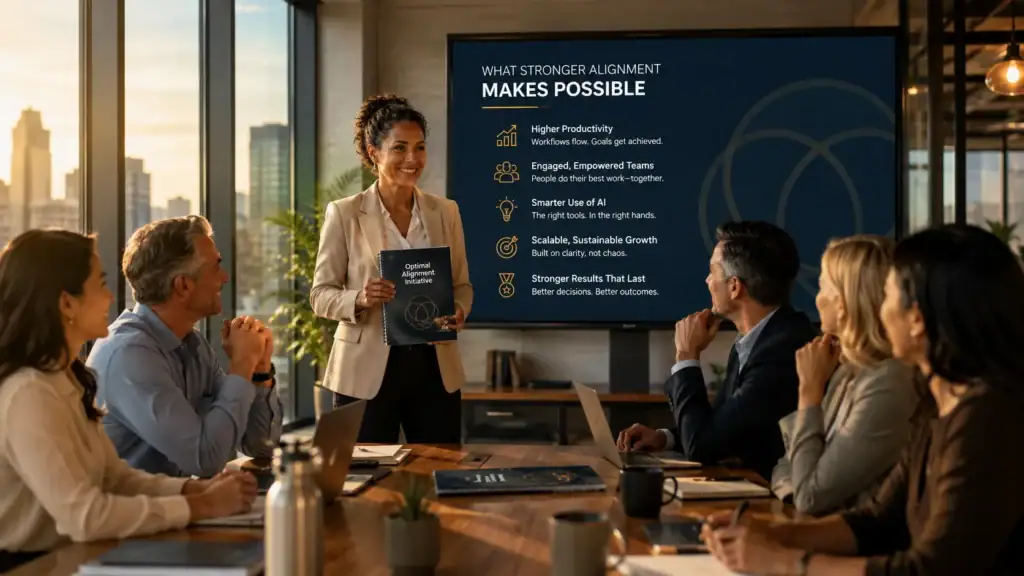
What Stronger Alignment Makes Possible

A more aligned organization can achieve:

  • Clearer roles and responsibilities
  • Faster, more consistent decisions
  • Reduced dependence on founders and key employees
  • Better use of employee strengths and expertise
  • More efficient workflows and handoffs
  • Improved accountability
  • Greater leadership visibility
  • Increased employee capacity
  • More purposeful use of AI
  • Stronger readiness for growth and change
  • A more scalable operating system

The engagement is typically led by the CEO or founder, often in collaboration with an HR leader or other senior executive.

OAI Office 7

The Optimal Alignment Team

Jim and Tom have been collaborating on excellence for 10+ years.

We recognize the societal shift taking place that will be the fastest upheaval in human history. This is not an exaggeration. Technology is advancing at an exponential rate of change.

AI is built to compete. Speed is AI’s advantage. Organizations that optimize technology and human resources will thrive while competitors struggle to survive.

We all know this is true so let’s get started aligning your organization for optimal performance. Take the assessment.

How Well Is Your Organization Aligned?

You don’t need to begin with a major consulting engagement. Start by gaining a clearer view of how effectively your people, roles, workflows, leadership practices, and AI systems are working together today.

The free Optimal Alignment Assessment can help reveal whether your organization has a strong alignment foundation or whether hidden gaps may be limiting capacity and performance.

Your Result May Indicate:

Moderate to Strong Alignment
Your organization appears to have a solid alignment foundation, with meaningful opportunities to strengthen performance, scalability, and AI integration.

Significant Misalignment
Your organization may be experiencing gaps involving roles, workflows, leadership dependency, underused talent, organizational capacity, or inconsistent AI integration.

Take the First Step Toward a More Aligned Organization

About Jim

Jim StableinFor more than 30 years, Jim Stablein has helped organizations communicate more effectively, adopt new technologies, and turn strategic ideas into practical solutions. A digital media and marketing strategist and founder of Mediafluent, Jim has extensive experience advising and collaborating with C-level leaders across marketing, sales, advertising, human resources, and organizational growth. Over the past two years, he has become an AI-native strategist and creator, using AI as an integrated part of everyday planning, analysis, communication, and production. Jim brings the technological and systems perspective needed to ensure that AI supports an organization’s people rather than complicating what they do best.

About Tom

Thomas J Shields, The OptimalogistThomas J. Shields, “The Optimalogist,” brings a unique ability to see the strengths, potential, and hidden obstacles that others often overlook. A professional coach since 1994 and a certified CliftonStrengths coach, Tom holds a master’s degree in Educational Psychology, a bachelor’s degree in Business Management, and an associate degree in Marketing. His personal journey—from overcoming a lifelong visual impairment and serious health challenges to building a career devoted to helping others see themselves more clearly—shaped his distinctive approach to human development. Tom helps leaders and employees recognize how they naturally think, contribute, and perform so their roles and responsibilities can be aligned with who they are at their best.

The Optimal Alignment Assessment